
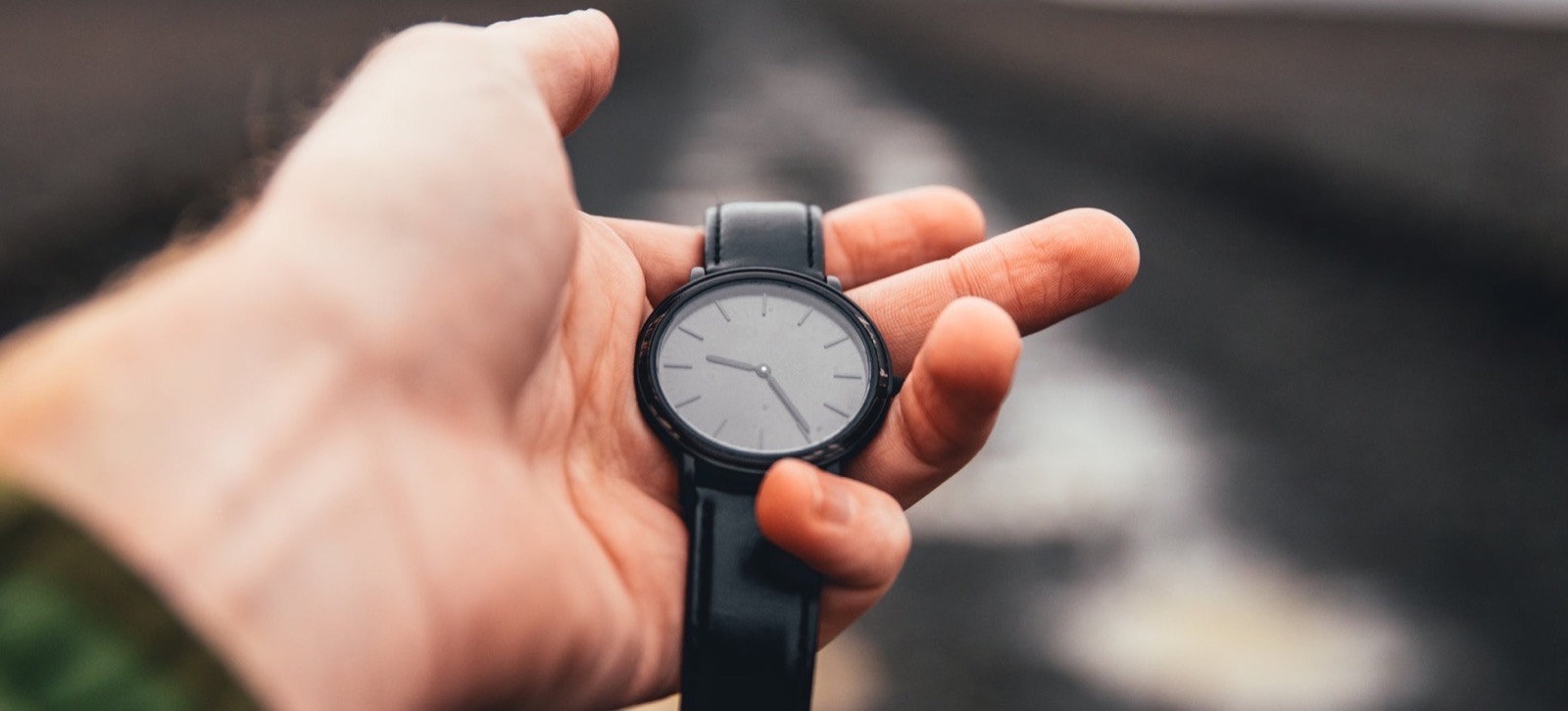
Short answer: a 45mm watch is too big only when its lugs hang over the flat top of your wrist. Measure that flat width with a ruler: under 55mm, choose a 43mm case; 55–62mm carries 44–45mm comfortably; above 62mm, almost any case sits inside the wrist. Case diameter on its own tells you very little — the lug-to-lug length and the shape of your wrist decide whether a watch wears large or absurd.
Most size guides are written for 38–40mm watches, where the answer is almost always "it fits". T-ENGINE's range runs 43–45mm, so the question is real: the Apex is 45mm, the Horzonte is 43mm, and those two millimetres change who each watch suits. This guide gives you one measurement to take, what 45mm actually looks like on a 160mm wrist, and the three adjustments that make a large watch wear smaller.
The only measurement that matters
Forget your wrist circumference for a moment. A watch sits on the flat top of your wrist, between the two wrist bones, and that flat surface is what a case has to fit. Two people can both have 160mm wrists and flat widths of 52mm and 60mm; the same 45mm watch will look enormous on one and normal on the other.
To measure it:
- Turn your palm face up and relax your hand.
- Lay a ruler across the flat top of your wrist, just below the wrist bone, and note the width in millimetres at the point where the surface starts to curve away on each side.
- Write the number down. That is your working width for every watch you will ever buy.
Case diameter is a proxy for that number, not a substitute. A 45mm case with short, curved lugs can wear smaller than a 43mm case with long, straight ones. Lug-to-lug — the distance from the tip of one lug to the tip of the other — is the number that actually spans your wrist, and it is worth asking for on any watch you are considering. If the lugs are longer than your flat width, the case overhangs, and no strap will fix it.
Why wrist circumference misleads
Wrist circumference is the number every size chart asks for, and it is the least useful one. It tells you how much strap you need, not how much room there is for a case. A wrist can be 160mm around and still be narrow across the top, because circumference includes the sides and the underside, where a watch never sits.
Circumference does have one use: it sets the minimum strap length. If your wrist is above 190mm, check that the band will close before you fall in love with the dial. Below that, ignore it for sizing and use the flat width instead.
There is a second reason size charts mislead: they are written to sell watches. A brand that only makes 40mm cases will tell you 40mm is the safe default. A brand that makes 45mm cases will tell you 45mm is bold and confident. Neither is a measurement. Your wrist is.
What 45mm looks like on a 160mm wrist
A 160mm circumference is a common wrist size, and it is where the 43-versus-45 question gets decided. On a 160mm wrist, the flat top is usually somewhere between 54mm and 58mm. A 45mm case therefore covers almost the entire flat surface: the lugs sit close to the edges, and the watch reads as a full, deliberate piece rather than a discreet one. That is a look, not a fault — but it has to be chosen.
| Flat wrist width | What fits | T-ENGINE example |
|---|---|---|
| Under 55mm | 43mm case, short lugs | Horzonte, 43mm, USD 139 |
| 55–62mm | 44–45mm case | Apex, 45mm, USD 90; Pettger - Silicon Band, 44mm, USD 99 |
| Above 62mm | 45mm and larger read as normal | Apex, 45mm, USD 90 |
A 43mm case leaves a visible strip of skin on either side of the lugs on most 160mm wrists; a 45mm case often leaves none. Neither is wrong. The strip of skin is what makes a watch look sized; its absence is what makes a watch look bold. Decide which you want before you decide which watch.
Three ways to make a large watch wear smaller
1. Fix the sleeve, not the watch. A cuff that ends at the case edge frames a 45mm watch and makes it look intentional. A cuff that swallows it makes the watch look borrowed from someone larger. If your shirt cuffs are tight, a 45mm case will keep catching; a looser cuff or a short sleeve solves more than a smaller case would.
2. Keep the dial dark and the case thin. Thickness and colour change perceived size more than diameter does. A dark dial on a slim case reads smaller than a pale dial on a thick one, and a wide bezel adds apparent width even when the case measures 43mm. When you compare two watches, compare them in profile as well as face-on.
3. Match the band to the wrist, not to the outfit. A band that tapers towards the buckle makes the case look proportionate; a wide, stiff band emphasises it. On a metal bracelet, remove links until the watch sits still rather than sliding over the wrist bone — a watch that turns on the wrist always looks bigger than one that stays put.
When to choose 43mm instead
Choose 43mm if any of these is true:
- your flat wrist width is under 55mm;
- you wear tailored long sleeves most days;
- you want the watch to sit under a cuff rather than on top of it;
- you are buying your first large watch and are not sure.
The Horzonte is T-ENGINE's 43mm option: a 316L stainless steel case, 3 ATM splash resistance, USD 139. The smaller case is not a lesser watch — it is the same design language at a size that fits more wrists and more shirt cuffs.
The overhang test
Before you buy, do this with a watch you already own, or with a paper cut-out of the case at its real diameter:
- Place the watch on the flat top of your wrist, centred.
- Look at the lug tips. If they sit inside the flat surface, the watch fits. If they hang over the curve, it is too big — or its lugs are too long.
- Move your hand up and down. If the case presses into the back of your hand, the lug-to-lug is too long for you.
This test is more reliable than any product photo. Product shots are taken on a stylist's wrist, often with the watch pushed up the forearm, which makes a 45mm case look like a 40mm one.
Does a metal band make a watch look bigger?
Yes, usually. A metal bracelet holds the case at its full width and adds visual weight at the lugs, while a silicone or leather band tapers away and lets the case stand alone. The same watch head can look a size larger on a bracelet than on a strap.
That is useful if you want presence and a problem if you are already at the limit of your wrist. If you measured 55–58mm and want a 45mm case, try it on a band that tapers; if you measured under 55mm, the bracelet version of a 45mm watch is the version most likely to look too big.
Which T-ENGINE watch fits your wrist
If you measured under 55mm, start with the Horzonte at 43mm, USD 139.
If you measured 55–62mm, the Apex at 45mm, USD 90, or the Pettger - Silicon Band at 44mm, USD 99, both sit comfortably.
If you measured above 62mm, any 45mm case will read as normal; the Apex is the broadest choice, with several dial and case combinations at USD 90.
Whichever you choose, check the case material before you commit: a steel case feels heavier than an alloy one at the same diameter, and weight is half of what people call "too big". Our guide to watch case materials explains the trade-offs.
T-ENGINE is a Hong Kong watch brand making drum-roller watches, sold direct from USD 89. The range runs 43–45mm, with 3–5 ATM resistance depending on the model.
If you would rather compare sizes side by side, browse all watches.