
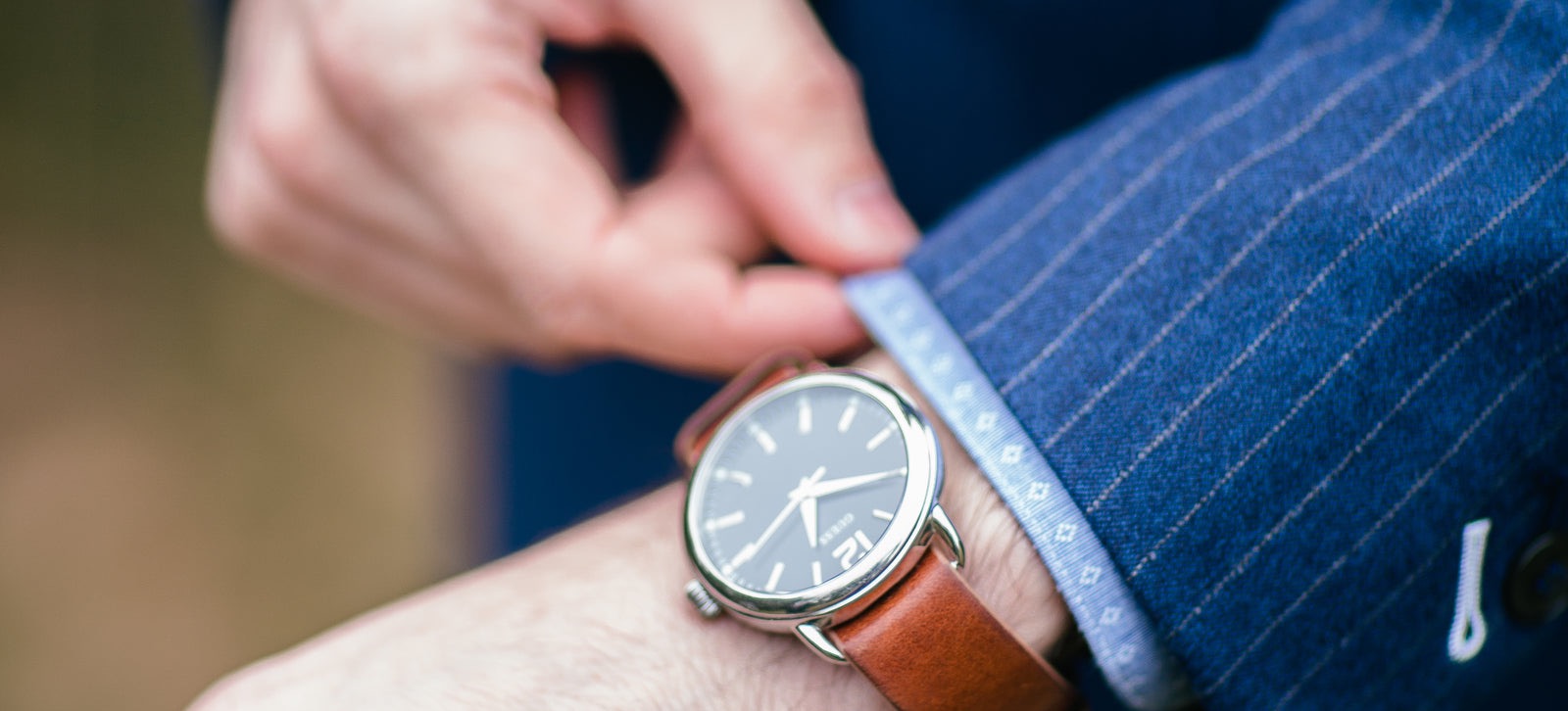
A watch disappears under a shirt cuff when the case is thicker than the space inside the cuff. For tailoring, a 43mm case such as the Horzonte sits more easily under a tailored cuff; a 45mm Apex needs a looser cuff or short sleeves. Fix the cuff fit first, the case second. T-ENGINE is a Hong Kong watch brand making drum-roller watches, sold direct from USD 89, and the same problem appears on both sides of its range.
The frustrating part is the size. The watch that vanishes is usually the big one, the 45mm case chosen because it looked substantial in a photograph. On a bare wrist it does. Under a buttoned shirt it becomes a lump under cloth, and the dial you paid for is hidden by the sleeve you wore to look formal.
The gap between case and cuff
A shirt cuff is cut for a wrist, not for a wrist plus a watch. The loop has to pass over the widest object on the arm, and that object is no longer bone. It is a 45mm case, a strap, and a buckle.
Three things decide whether the cuff clears the watch:
- The cuff opening. A buttoned cuff has only a centimetre or two of ease. A 45mm case can use all of it.
- The case edge. The bezel and lugs are what fabric catches on. A smooth 43mm case slides; a 45mm case with a proud bezel grips.
- Where the watch sits. A watch pushed up the forearm meets a narrower part of the sleeve, so the fabric has less room, not more.
When the cuff cannot pass the case, it stops on top of it. The fabric bunches at the wrist, the dial turns into a shadow, and the watch looks smaller than it is. Nothing about the movement or the dial has changed. The shirt has won.
Where the cuff should sit
Fasten the cuff first, then put the watch on. That order tells you immediately whether the sleeve can clear the case.
A shirt cuff should end at the wrist bone, with the watch sitting just below it on the flat of the wrist. A jacket sleeve should show about 1–1.5cm of shirt cuff when the arm is at rest. If the watch is fighting the shirt for that same centimetre, the shirt will win every time you move.
There are two workable positions. The cuff can sit behind the watch, resting on the strap rather than the dial. Or the cuff can pass over the watch with enough room that the fabric does not press on the crystal. What fails is the middle: a cuff long enough to cover the dial but tight enough to grip the case. That is the combination that makes a good watch look like a bad fit.
Fix 1: the cuff, not the watch
The cheapest fix is the shirt. A tailor can let out a cuff by 0.5–1cm or move the button by 5mm for less than the cost of a strap. The change is invisible when worn and it solves the problem at the source.
Four practical moves, in order of effort:
- Move the cuff button outward by 5mm. This adds real room without changing the shape of the sleeve.
- Have the cuff let out. Most shirts have enough seam allowance for 0.5–1cm. A dry cleaner with an alterations counter can do it.
- Choose a relaxed cuff on the next shirt. A box-pleat or single-button cuff with a wider opening clears a large case without looking loose.
- Do not stretch the cuff. Fabric that has been pulled will return to its old size after one wash, usually tighter.
Sleeve length matters too. A cuff that ends past the wrist bone has already used the space the watch needs. Shortening the sleeve by 1cm can do more than changing the watch.
Fix 2: choose 43mm for tailoring
If the shirt cannot be changed, change the case. The difference between 43mm and 45mm sounds small — 2mm across, about 1mm on each side — but at a cuff that millimetre is the difference between fabric resting on the strap and fabric sitting on the crystal.
The Horzonte is the tailoring answer: a 43mm case in 316 stainless steel, 3 ATM, USD 139. It is still a large watch by dress-watch standards, where 36–40mm is normal. It is simply small enough to clear a buttoned cuff without the shirt having to be rebuilt.
The Apex is the 45mm counterpoint: an alloy case, 3 ATM, USD 90, on a silicone strap or a stainless steel bracelet. On a bare wrist or a loose cuff it has the presence the Horzonte deliberately gives up. Under a tight buttoned cuff it is the watch that disappears.
If you are unsure which size your wrist can carry, the watch size guide covers the measurement in detail. For the cuff question, the rule is simpler: if the shirt is tailored and buttoned, start at 43mm.
Fix 3: short sleeves and the bare wrist
The honest answer to a hidden watch is to stop covering it. Short sleeves remove the variable entirely, and a 45mm Apex is at its best with nothing between the case and the light.
For long sleeves without a buttoned cuff:
- Roll an oxford sleeve to just below the elbow. A wide, flat roll stays put; a tight roll around the forearm just creates a new cuff higher up.
- Push a knit cuff behind the case. Ribbed cuffs grip, so let them sit on the strap rather than over the dial.
- Wear the watch on the outside of a slim sweater cuff only if the knit is tight. On a loose knit, the watch will pull the whole sleeve down.
| Cuff situation | 43mm Horzonte | 45mm Apex |
|---|---|---|
| Buttoned tailored shirt, standard cuff | Sits cleanly; best match | Catches unless the cuff is let out |
| Buttoned cuff with 1cm extra room | Fine | Works |
| Oxford cloth, sleeves rolled | Fine | Good |
| Ribbed knit cuff | Push cuff behind the case | Push cuff behind the case |
| Short sleeve or no cuff | Fine | Best showcase |
Why a drum dial survives a half-covered wrist
Most watches fail the cuff test at the same point: the hands. They radiate from the centre, so a sleeve that covers the top half of the dial can hide the hour hand completely. You tilt your wrist, the cuff moves, and the time appears for a second.
A drum-roller watch reads differently. The time is printed across rotating drums in a horizontal line rather than swept by hands from a pivot. Cover the upper edge of the dial and the line can still fall inside the visible band. The watch does not need to be fully exposed to be read.
That is the design bet behind T-ENGINE's Three Roller Series: a display that stays legible in the middle of real life, including the half-covered wrist at a desk. It is not a reason to wear a tight cuff. It is a reason the watch still earns its place when you do.
The fix, in one sentence
Fix the cuff before you fix the watch: a 5mm button move or a 1cm let-out will rescue most 45mm cases, and if the shirt is staying as it is, the 43mm Horzonte is the version built for a tailored sleeve. The 45mm Apex is for the bare wrist, the rolled sleeve and the looser cuff.
Both are in the full watch range, alongside the rest of the 14 pieces. Start with the sleeve you actually wear, then choose the case that fits it.