
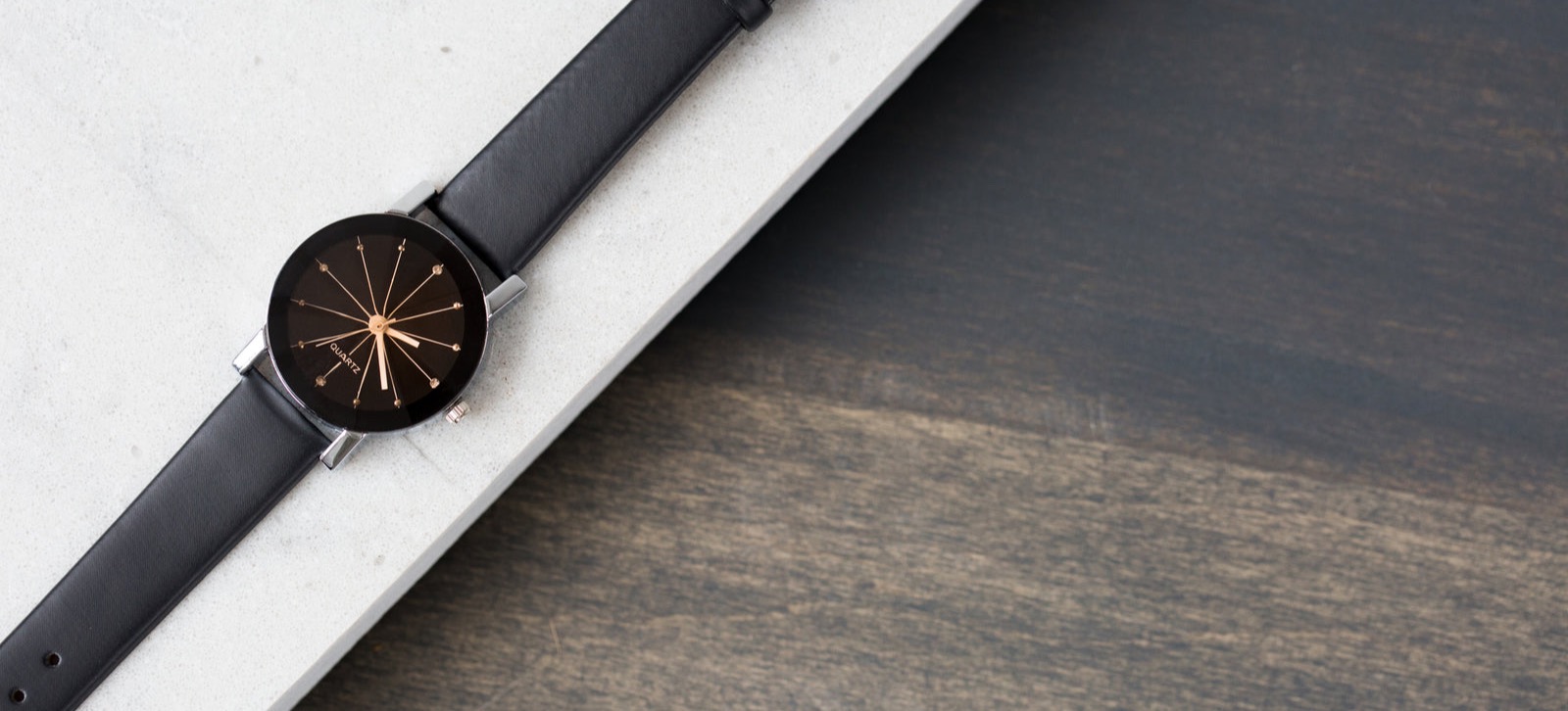
A quiet luxury watch keeps branding to a small wordmark or removes it altogether, finishes the case in brushed or matte metal rather than mirror polish, and gives the dial one clear job. It looks expensive because nothing on it is asking for attention. T-ENGINE is a Hong Kong watch brand making drum-roller watches, sold direct from USD 89, and the quietest pieces in its fourteen-reference range follow the same three rules.
The phrase moved from fashion into watches around 2023, when buyers tired of monograms and started paying for cashmere with no label. In watches the swap is the same: status moves from the emblem on the dial to the finish on the case. The catch is that "quiet" is now a marketing word too, and a plain watch is not automatically a good one.
What quiet luxury actually means
Quiet luxury is a claim about signals, not about price. A loud object tells you what it cost before you have touched it: a logo, a repeating monogram, a bezel in polished gold. A quiet object makes you look twice, and the second look is where the quality has to be.
Three things happen when a watch goes quiet:
- The dial loses its advertising. No crest at twelve, no name repeated around the chapter ring, no badge on the crown side.
- The case takes the attention. Brushed steel, a matte bezel, an edge that catches light for a millimetre and then stops. This is finishing you can see without a logo pointing at it.
- The function narrows. Time only, or time plus one useful extra. A dial with six subdials is a brochure; a dial with two drums is a tool.
None of that requires a high price. It requires restraint, which is cheaper to design than a monogram.
The 3 signals: no logo, brushed case, one function
Restrained branding. The strict version has no writing at all. The practical version allows a small wordmark, the maker's name in 4mm type at twelve o'clock, because a watch with no name anywhere can read as a blank sample rather than a product. What quiet luxury rules out is the emblem: the shield, the coronet, the interlocking letters, the logo printed on the strap. T-ENGINE prints its name small on the dial and stops there — no crest, no repeated pattern, no badge on the buckle.
A brushed or matte case. Polish is a mirror, and a mirror on the wrist says "look here". Brushing scatters light instead, so the case reads as one soft shape. It also hides the small scratches that a polished case collects in a month of desk work. On a USD 89–139 watch this matters more than on a luxury piece, because the case is a larger share of what you paid for.
One clear function. Quiet luxury is not the same as empty. A single complication done properly — a date, a second time zone — still reads as considered. Three complications crammed into 40mm read as a catalogue page. The test is whether you can explain the dial in one sentence. On the Drifter the sentence is "the hours and minutes are printed on two rotating drums".
| Signal | Loud version | Quiet version |
|---|---|---|
| Branding | Emblem, monogram, logo on the strap | Small wordmark, or nothing |
| Case finish | Full mirror polish | Brushed top, polished edge only |
| Dial | Six subdials, three colours, applied crest | One function, two colours, printed markings |
| Strap | Logo-stamped buckle, contrast stitching | Plain buckle, matched stitching |
Why loud watches feel dated
A logo dates because it is fixed graphic design. The shape that looked confident in 2016 reads as a period detail in 2026, and marketing cannot move it forward. Finish does not date the same way: brushed steel in 1974 and brushed steel now are the same idea.
There is a second reason, and it is photographic. Social feeds reward the thumbnail, and a big emblem survives a 200-pixel crop better than a brushed bevel does, which pushed design toward bigger marks for a decade. The correction is visible in what people now photograph: a cuff, a case edge, a dial with little written on it.
How a drum dial fits
The drum-roller display is unusually well suited to this look, because the time itself is the graphic. Instead of hands sweeping from a centre pivot, the hours and minutes are printed across rotating drums and read as a horizontal line. There is no empty space that needs filling with a crest, and no subdial that needs a colour to stand out.
T-ENGINE's quietest options sit at three price points:
- The Drifter is the 45mm alloy case at USD 90, on a silicone strap or a steel bracelet. It is the plainest expression of the idea: matte dial, two drum windows, nothing else.
- The Maneuver is a 44mm stainless steel case at USD 110, with a second time zone and a chronograph, on leather or a steel bracelet: one extra function without a busier dial.
- The Brairgu is also 44mm stainless steel at USD 110, rated to 3 ATM, with the same dual-time layout. The brown and tan dials are the warmest of the three.
All three use the same reading system, and none of them puts an emblem between you and the time. If the display is new to you, the explainer on how a drum roller watch works covers the mechanism in plain terms.
What to wear it with
The outfit rule is simpler than the watch rule: keep one metal tone and let the watch be the quietest hard object you are wearing.
| Situation | What works | Why |
|---|---|---|
| Charcoal or navy suit | Brairgu on the leather strap, 44mm, USD 110 | Brown leather softens the steel; the drum window reads as a detail, not jewellery |
| Grey knit, dark trousers | Drifter, 45mm, USD 90 | The matte dial disappears into wool; the case edge is the only shine |
| White tee and denim | Drifter on silicone | Rubber and jersey belong together; no bracelet to scratch a desk |
| Travel with two time zones | Maneuver, 44mm, USD 110 | The second zone is set once and read at a glance |
| Black tie | No watch, or a thin dress watch you already own | A 43–45mm sports case is not a black-tie object, however quiet the dial |
That last row is the honest one. Quiet luxury does not make a big watch formal. If the invitation says black tie, wear an empty wrist or a 36–38mm dress watch from elsewhere; T-ENGINE's range is built for the other four rows.
The price trap
"Quiet" has acquired a price floor in fashion, where an unlabelled cashmere coat can cost four figures and the absence of a logo is part of the pitch. In watches the same trick appears at USD 3,000 and up: a plain three-hand watch sold on the idea that restraint is itself a luxury material.
Some of that money buys something real — hand-finished bevels, an in-house movement, a bracelet with 200 polished links. Most of it buys positioning. The useful question is not "how quiet is it" but "what did the money go into".
At USD 89–139, T-ENGINE is not pretending to compete on hand finishing. The money goes into the drum movement, the case, the strap and the packing, and the watch is assembled and shipped from Hong Kong. Dispatch is within two business days, standard shipping is free worldwide and takes seven to fourteen business days, and the movement carries a two-year warranty. That is an honest object at an honest price, which is the only version of quiet luxury that survives a close look.
Two practical limits are worth knowing before you choose. The Drifter and Brairgu are rated to 3 ATM, which covers rain and handwashing but not swimming. The Maneuver is rated to 5 ATM, which is fine for a pool but not for diving. None of the three is a safe queen, and none of them needs to be.
If you want a watch that says nothing and shows everything in the finish, start with the Drifter at USD 90 and compare it against the Maneuver and the Brairgu. All fourteen references are in the full watch range, and the quietest ones are the ones with the least to read.