
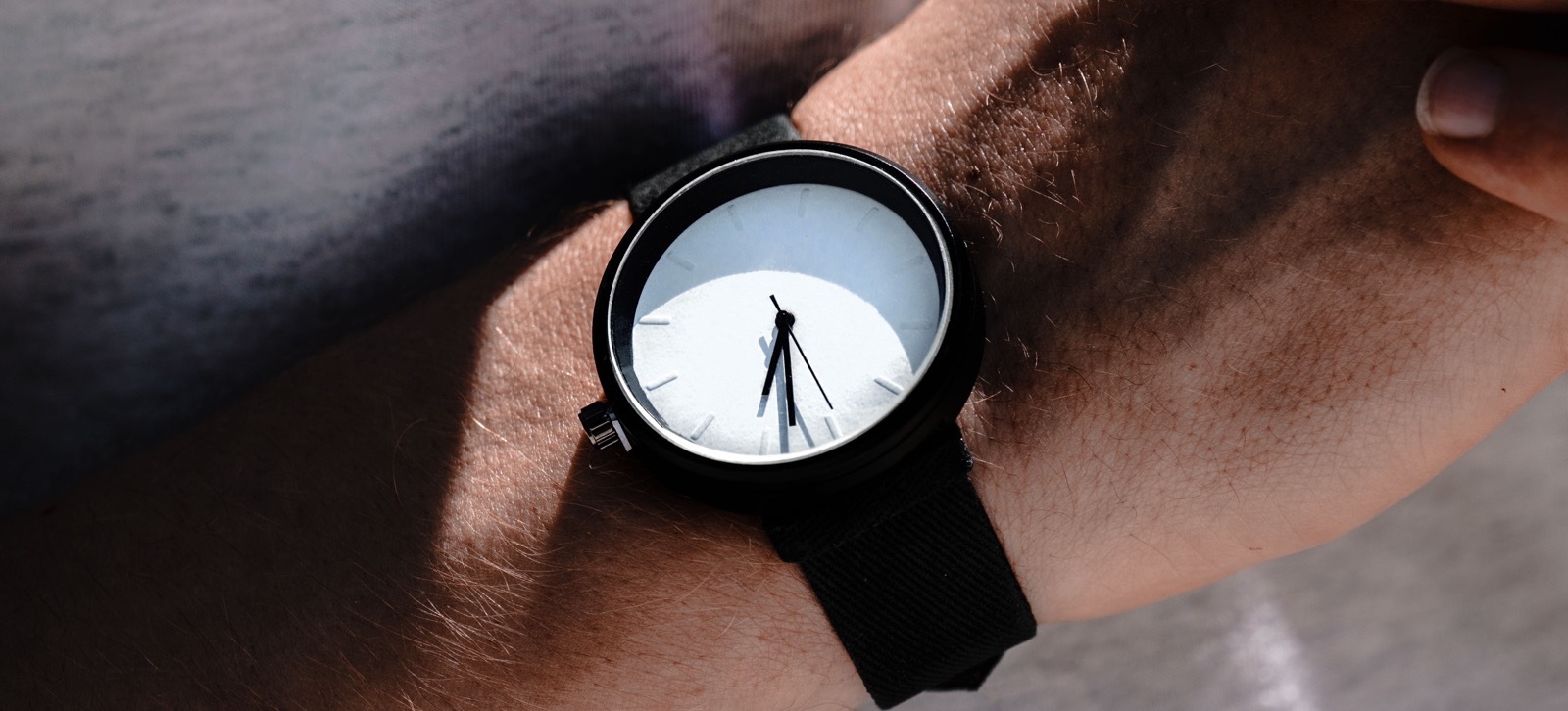
A drum roller watch shows time on rotating numbered drums instead of hands. T-ENGINE's three-roller movement puts the hour and minute digits on three drums in a row, so the time reads as a horizontal line rather than a circle. T-ENGINE is a Hong Kong watch brand making drum-roller watches, sold direct from USD 89.
That definition matters because "drum roller" gets used loosely online. It is not a jump-hour watch, not a smartwatch with an animated face, and not a tourbillon. It is a display where numbered cylinders turn behind a window. This guide covers how the drums work, why the layout reads quickly, where the idea came from, and what it is like to live with.
A watch without hands
A conventional watch asks your eye to do two things at once: find the hour hand, find the minute hand, then translate their angles into a number. You have done it since childhood, so it feels instant, but it is still a decoding step. A drum roller removes that step. There are no hands to compare and no angles to estimate. You look at a fixed window and read a row of digits, left to right.
The display is built around three cylinders, or drums, mounted side by side behind the dial. Each drum carries printed digits on its outer surface. As time passes, the movement indexes the drums forward one position at a time, bringing the next digit into the window. The case and strap are ordinary watch parts; the difference is behind the glass.
Because the drums are physical, the digits are printed, not lit, and the window edge casts a small shadow across them. Under direct sun you can see the curvature of the drum. It reads like an instrument rather than a gadget.
How three drums show hours and minutes
The three drums divide the time into three digit positions. One drum carries the hour, and the other two carry the minute digits. At 09:47, the window shows 09 and 47 across the row, with the two groups separated by a small printed marker. At the next minute, only the last drum moves. At the next hour, the hour drum steps and the minute drums reset.
That division is why the movement needs three drums rather than one. A single cylinder would have to carry every possible hour and minute combination, making it enormous or the digits unreadably small. Three short tracks keep each drum compact and each digit large enough to read at a glance.
The indexing is deliberate rather than continuous. A hand sweeps smoothly; a drum clicks from one digit to the next. The transition takes a fraction of a second, and for most of that minute the display is still. A quick glance can catch the exact moment the minute changes, which is oddly satisfying.
The table below sets out the practical differences.
| What you compare | Analog hands | Three-drum roller |
|---|---|---|
| What moves | Hands sweep around a circle | Drums index in a straight row |
| How you read it | Decode two angles | Read digits left to right |
| Where you look | The whole dial | A fixed horizontal window |
| Change per minute | Continuous movement | One discrete step |
| Design reference | Pocket watch and clock face | Dashboard counter and odometer |
| Best light | Any | Strong contrast helps; the window shadows the digits |
The drums sit slightly recessed, so the window shades them in low light. In daylight and office lighting the display is crisp. In a dark bar, you will tilt your wrist toward the light, the same way you would with a dark analog dial.
Why a line reads faster than a circle
Reading a line is faster than reading a circle because the information arrives in the same order every time. Your eye starts at the left edge of the window and moves right, and the digits never swap places. With hands, the same information is spread around 360 degrees, and the position of each hand changes the meaning of the other.
This is a claim about glance time, not taste. In a moving car, on a bike, or in a meeting, the useful question is how many seconds you need to look down. A row of digits answers it in one fixation. A pair of hands usually needs two: one to locate the hands, one to compare them.
A horizontal line also photographs well. In a square crop, a row of digits fills the frame and stays legible at thumbnail size; a circular dial loses its hands and turns into a dark disc. That is why the layout suits the way watches are now discovered on small screens.
The trade-off is character. A sweeping second hand gives a mechanical watch much of its visible life. A drum roller is quiet by comparison, and some wearers miss the motion. If you like watching a movement work, a roller display is the wrong choice. If you like reading time without ceremony, it is the right one.
The 1970s dashboard connection
The drum display did not begin with watches. It began with counters. Mechanical odometers, trip meters, rally clocks and industrial instruments all used numbered drums because a drum is simple, robust and easy to read in a hurry. In the 1970s, car interiors pushed instruments toward the driver's line of sight and used white numerals on black, with a single accent colour for the needle.
Watch designers borrowed that language: bold numerals, matte black backgrounds, a rectangular window and one warm accent colour all migrated to the wrist. The drum roller is the purest version of the idea, using the same mechanical counter the dashboard used.
T-ENGINE's own design language comes from that period. The cases are large and flat, the dials are graphic, and the display is built around a horizontal read. The drums are the watch, not an extra feature added to a conventional face. The same logic shapes the finishes: a brushed or matte surface keeps attention on the window, while a polished bezel would compete with it. The guide to watch case materials explains how those finishes change the way a large case wears.
The connection also explains the size. A dashboard instrument is read at arm's length, so its numbers are oversized. A 45mm case gives the three drums room to print digits at a similar scale. Shrinking the display to 38mm would force the digits smaller and remove the one advantage the layout has. That is why the Three Roller Series stays at 44mm and 45mm.
What it is like after a week
The first two days are slower than you expect. You look at the window, find the digits, and then unconsciously look for hands that are not there. The habit takes a few glances to break. By the third day, the read becomes direct: you see 10:18 as a number, not as a position.
The surprise is how often you use it without thinking. Checking the time in a meeting, in a taxi, or while cooking becomes a single glance rather than a small calculation.
The drums are sealed behind the crystal, so there is nothing to service day to day beyond normal watch care. T-ENGINE rates the Three Roller Series at 3 ATM, which covers rain, handwashing and splashes but not swimming. The warranty runs two years on the movement.
One honest limitation: the display is not luminous. There are no hands to coat and no indices to glow. If you need the time in a dark room without a light, a conventional dial with luminous hands is the better tool; the drum roller is a daylight and indoor design.
The T-ENGINE models that use it
The Apex is the clearest entry point. It has a 45mm alloy case, 3 ATM water resistance, a silicone strap or a stainless steel bracelet, and five colour combinations at USD 90. The black dial on a steel case is the most restrained version; the yellow dial looks most like a 1970s instrument.
The Drifter uses the same 45mm case and three-drum display at USD 90, with a wider choice of dial colours including red, yellow, white and black. Choose it if you want the display to be the loudest thing on your wrist.
The Slearvo is the exception. It is a 44mm watch that combines the drum roller with an analog hand set, adds a dual time zone and a chronograph function, and sells for USD 100. It suits someone who wants the roller read but is not ready to give up hands entirely.
All three use the same core idea: time as a horizontal line. You can compare the full range, including the 43mm Horzonte and the dual-time Racer 17, in the watch shop. If you are still deciding between a metal bracelet and a silicone band, the guide to which strap comes with your watch covers the same case on both.
FAQ
How do you read a drum roller watch?
Read the digits in the window from left to right. The first group is the hour and the second group is the minute. At 09:47 the window shows 09 and 47, separated by a small marker. There are no hands to compare, so you read the number directly.
Is a drum roller watch reliable?
The drums sit sealed behind the crystal and the watch carries a two-year movement warranty. T-ENGINE rates the Three Roller Series at 3 ATM for rain and handwashing, so the display is protected in normal daily use. Avoid swimming and hard knocks.
Drum roller vs jump hour: what is the difference?
A jump-hour watch shows one hour digit in a small window and usually keeps a conventional minute hand or disc. A drum roller shows the hour and both minute digits on three separate drums at once, so the whole time reads as a single horizontal line. The jump hour displays the hour; the drum roller displays the entire time.